
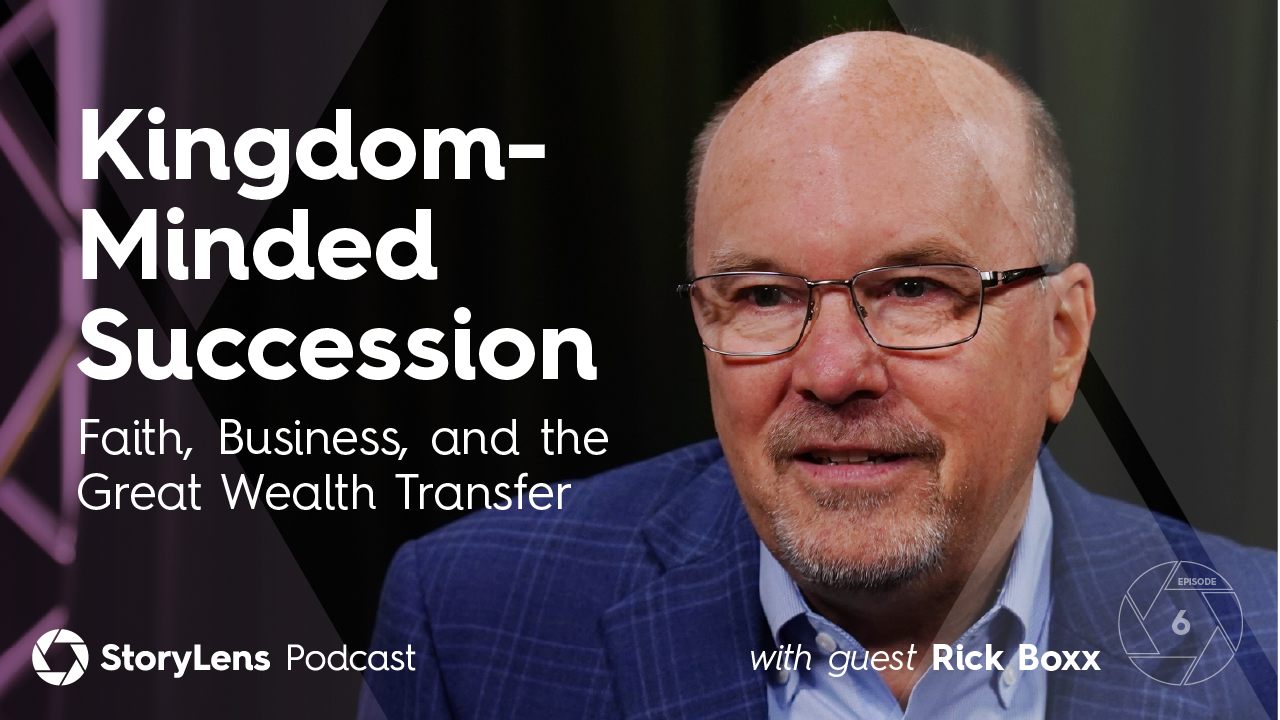
11 Dec Kingdom-Minded Succession: Faith, Business, and the Great Wealth Transfer
Wealth transfer is not just a technical event. It is a deeply personal moment where calling, culture, family, and generosity all collide.
In Episode 6 of the StoryLens Podcast, StoryOne partners John Christensen and Cameron Bond sit down with Rick Boxx, founder of The Unconventional Business Network, to explore various options for a kingdom-minded business transition. They talk about integrating faith at work, the emotional weight of exits, and how to steward both wealth and influence as ownership changes hands.
Who is Rick Boxx and what is The Unconventional Business Network?
For more than two decades, Rick has led The Unconventional Business Network, a ministry that helps business leaders integrate biblical principles into the way they run their companies.
Rick hosts conferences in Kansas City and Des Moines, leads a national faith-based events, shares a daily workplace devotional on hundreds of radio stations and on the YouVersion Bible App, and provides video-based community groups for leaders in companies, churches, and Fortune 500 employee resource groups.
As Rick puts it, “We believe the Bible is the best business book you’ll ever get your hands on if people would just read it through the lens of a business person.”
Why does integrating faith and work matter so much?
Many Christian business owners assume faith is for Sundays, and business is for weekdays. Rick points to Barna research showing that only about 28% of Christians integrate their faith and work. The remaining 72% are either compartmentalizers — Sunday looks very different than Monday — or onlookers who do not see their work as a calling.
That disconnect has real consequences. Employees spend nearly half their waking hours at work, which means the workplace is often the best mission field and the place where leaders have the most influence.
Rick’s heart is to help business owners see that God cares not only that they make money or give it away but also how they conduct business — how they handle conflict, treat employees, resolve issues and model forgiveness.
What is the Great Wealth Transfer, and why is it happening slower than expected?
The baby boomers as a generation, have amassed wealth in the form of investment portfolios, private real estate, private equity, and closely held businesses. The “Great Wealth Transfer” is baby boomers passing their wealth to their children and grandchildren. For years, advisors have talked about the Great Wealth Transfer, the coming wave of business and asset transitions as aging business owners retire or pass away. Rick agrees it is real but notes it seems to be moving slower than originally predicted. Many baby boomers are living longer and staying engaged in their businesses later in life, often delaying retirement.
In business succession and wealth transfers, the opportunities and risks are significant. Businesses, farms, and real estate are transferring from one generation to the next or being sold to third parties. Business owners often feel overwhelmed by the complexity and are not sure where to turn because business succession or sales require a whole team: legal, tax, financial, and sometimes even counseling support. The goal of a robust financial plan and succession plan is to create a strategic path for business owners, their business, and their family.
Why is succession planning emotionally hard for entrepreneurs?
-
- It’s often unclear for families who are focused on “fairness” how to treat children, when some work in the family business while others do not.
- Siblings within the second generation may have very different desires; some want to keep the business intact, while others want cash.
- When selling to a third party, some family members may have opportunities with the new company, while others do not.
- Often, old wounds or sibling rivalries resurface and turn a transition into a flashpoint rather than a celebration.
How should business business owners think about generosity as part of succession?
One of the most striking parts of the conversation is how generous many successful business owners are.
John describes explaining his work to a electrical engineer from Pakistan who was surprisedby the level of charitable giving done by American business owners and entrepreneurs. For many business owners, years of “blood, sweat, and tears” in building a business eventually flow into a desire to bless churches, ministries, and their community.
Rick shares his own experience with one of his early estate plans where generosity was never even mentioned during the planning process. The attorney delivered a finished plan that did not reflect Rick or his wife’s charitable intent. It was a wake-up call that many advisors never raise the generosity question unless the client pushes for it.
Tools like donor-advised funds, supporting organizations, and foundations can help business owners integrate charitable giving into the succession plan before a sale and not just after, often with significant tax benefits. When dealing with a closely held business or family business, there are huge tax benefits from incorporating pre-sale charitable gifts into the succession plan. Because of various tax laws, business owners cannot replicate the leverage created by making charitable gifts of stock prior to selling their business. A pre-sale charitable gift adds some complexity to the transaction but is often worth the effort.
Why is it important to plan for your life after the exit or liquidity event?
Business owners often invest tremendous energy into the company’s succession plan,yet neglect their own financial plan or personal life plan.
On the personal life plan side, Rick tells the story of a friend who executed a beautiful multi-year transition, handed the business off well, and then realized he had not thought about his own future. After the deal, he sat at home and said, “The phone no longer rings. Nobody cares about my decisions, and I don’t know what I’m supposed to be doing.”
A healthy exit strategy should answer two questions:
- What will happen to the business, employees, and customers?
- What will my purpose, calling, and community be after I step away?
Without both, even a financially successful sale can leave an owner feeling lost.
What does it mean to pursue a kingdom-minded transition?
-
- Is this really my business, or is it God’s business that I have been stewarding for a season?
- Am I racing toward the highest price, or thoughtfully asking what outcome God would want?
- What will happen to the people I lead and the culture we have built once the ink is dry?
What first steps can business owners take?
If you are an owner starting to think about succession or a future sale, Rick suggests:
- Pray and reflect on what God may want, not just what you want.
- Start building a team of advisors early, including people who understand generosity and calling, not just tax and deal structure.
- Consider tools like donor-advised funds and kingdom-minded buyers or ESOP structures that can support both culture and giving.
- Begin planning your next chapter, so you have a sense of purpose after the deal.
At StoryOne, our goal is to help families think multi-generationally about both wealth and impact, aligning succession, generosity, and calling with a story that honors the true Owner. The earlier you create and implement a strategic plan for your business, the more options and flexibility you will have.
Stay Connected
Stay connected with the StoryLens Podcast for future conversations. Your story is anything but ordinary—and that’s exactly where we begin.