
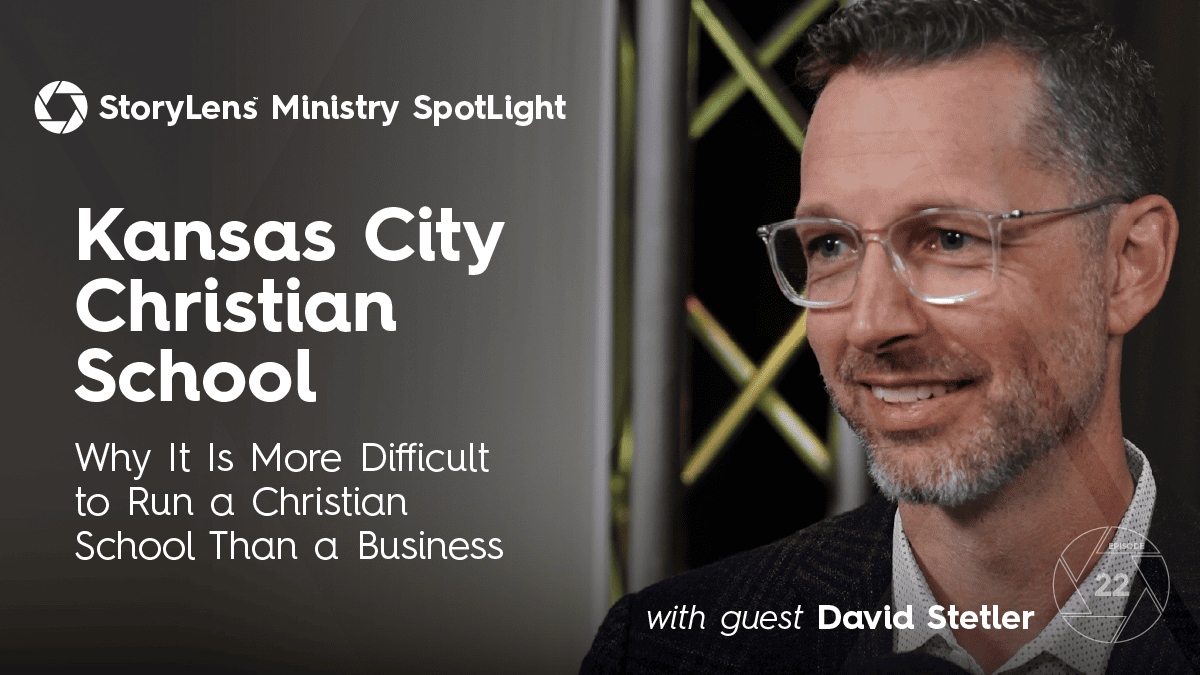
12 Nov Kansas City Christian: Why It Is More Difficult to Run Than a Business
From business leadership to full-time ministry, David Stetler has navigated complex organizations. But he says helping lead a Christian school presents a challenge unlike any other.
David Stetler has started, run, and sold businesses. He has served as a chief operating officer for companies both large and small. He has also spent ten years in full-time ministry.
Yet when he considers the challenges of each, he believes one stands apart: helping lead a Christian school.
Why? Because an independent Christian school must function as three things simultaneously—a school, a ministry, and a business. Each carries its own responsibilities, and all three must work together in service of a shared mission.
In the inaugural episode of the StoryLens™ Ministry Spotlight series, StoryOne’s John Christensen and Cameron Bond sit down with David, Board Chair of Kansas City Christian School (KCC), to explore what makes Christian education uniquely challenging, why its mission matters, and how generations of faithful investment continue to shape its future.
More Than a School
For more than 75 years, Kansas City Christian School has sought to provide an education rooted in biblical truth, academic excellence, and Christlike character.
Founded by ten Kansas City families in 1951, the school’s guiding principle was to teach every subject in light of God’s unchanging truth.
That vision remains central today.
But fulfilling it requires more than delivering a strong academic program. It requires teachers who see education as a calling, families who embrace a shared responsibility, and leadership committed to maintaining both the spiritual and operational health of the school.
For David, this is what makes Christian education particularly complex.
A business may focus on providing an excellent product or service. A ministry may organize its efforts around a clearly defined calling. A Christian school must bring those objectives together while educating and shaping young people during some of the most formative years of their lives.
Every hiring decision, classroom experience, extracurricular opportunity, and strategic investment becomes part of that responsibility.
And unlike a traditional business, success cannot be measured by financial performance alone.
The Influence of a Teacher, Coach, or Mentor
David understands the school’s mission from several perspectives. He attended KCC from kindergarten through high school, his parents were deeply involved in the school, and today all five of his children are students there.
Looking back, he recognizes how profoundly the teachers and coaches in his life shaped his understanding of faith, character, and excellence.
One memory stands out.
As a high school soccer player, David was part of a team that had gone two years without losing a game. After every match, the players gathered to recite an excellence creed—a declaration of their commitment to teamwork, effort, and pursuing their full potential.
But after one particular victory, their coach stopped them.
The team had won, but the players had arrived unprepared and failed to give their best effort.
“Not today. You don’t deserve it. You have to earn it.”
Those words stayed with David long after graduation.
The lesson wasn’t about winning. It was about character, accountability, and the responsibility to pursue excellence regardless of the outcome.
Years later, David overheard his own children describing him as someone who pursued excellence in everything he did.
He recognized the influence of the teachers and coaches who had invested in him decades earlier.
It is an example of how the impact of education often extends far beyond what can be measured in a classroom.
Academic Excellence and Spiritual Formation
During the conversation, David recalls an exchange with Christian philosopher Dallas Willard about how our understanding of God shapes the way we approach every aspect of life.
For KCC, that perspective informs the relationship between academic excellence and spiritual formation.
The two are not separate objectives competing for attention. They are intended to work together.
As David asks in the conversation:
“Clearly we’re all being formed, but what are we being formed by?”
Education shapes more than what students know. It influences how they think, how they relate to others, how they respond to challenges, and how they understand their responsibilities in the world.
At KCC, that formation happens through academic instruction, athletics, relationships, and the everyday example of teachers and mentors.
David describes the school’s approach as a balance of high support and high challenge.
Teachers care deeply for their students, but that care also means holding them to meaningful standards and helping them reach their potential.
“The teachers love my kids so much that they demand their best.”
It is a philosophy that reflects the school’s broader commitment to preparing students not simply for graduation, but for lives of faith, service, and purpose.
A Shared Responsibility
An independent Christian school cannot fulfill its mission in isolation.
Throughout the conversation, David and the StoryOne team emphasize the importance of partnership among parents, churches, educators, and the broader community.
For David’s parents, choosing KCC meant surrounding their children with adults who reinforced the same values being taught at home and at church.
Today, he sees that same partnership at work in his own children’s lives.
It is a reminder that education is not simply a transaction between a family and a school. It is a shared investment in the development of the next generation.
That partnership also extends to those who make the school’s work financially possible.
As John Christensen, who serves as Treasurer of KCC’s Board, explains, independent schools depend on the generosity of individuals and families who believe in their mission.
Some of KCC’s most generous supporters have never had children enrolled at the school. Some have never even visited the campus.
Their support reflects a belief that the value of Christian education reaches beyond the families directly served.
A Different Kind of Compounding
At StoryOne, conversations about investment often involve financial growth, long-term planning, and the power of compounding.
But the impact of investing in people can compound in ways that are much harder to quantify.
David sees this in the lives of KCC graduates who have become pastors, missionaries, business leaders, and parents raising families of their own.
The influence of a teacher, coach, or mentor may continue shaping decisions and relationships decades after a student graduates.
That influence can extend to families, workplaces, churches, and communities around the world.
It is a different kind of return on investment—one measured not simply in dollars, but in lives changed and opportunities created.
And it helps explain why generations of donors have continued supporting the school’s mission.
Expanding Opportunity Through the Urban Education Initiative
One example of that investment in action is KCC’s Urban Education Initiative.
Beginning approximately 15 years ago through a partnership with Freedom Fire, the initiative created opportunities for students from Kansas City’s urban core who might not otherwise have access to Christian education.
The goal extends beyond enrollment.
Through education, relationships, and a supportive community, students are encouraged to pursue academic achievement, develop confidence, and envision possibilities for their futures.
David shares stories of students whose experiences at KCC have helped open doors to college and other opportunities they may not previously have imagined.
But he also emphasizes that the impact goes both ways.
Students from different backgrounds build relationships, learn from one another, and contribute to a stronger school community.
It is an example of how KCC’s mission reaches beyond traditional academic outcomes to create opportunities for lasting personal and generational change.
Growing for the Sake of the Mission
After more than seven decades, Kansas City Christian is considering what its next chapter could look like.
With more than 400 students and a building that has experienced capacity limitations, the school’s leadership is exploring opportunities for expansion.
But David is careful to distinguish growth for its own sake from growth that strengthens the mission.
Additional capacity could create opportunities for stronger academic programming, athletics, fine arts, and other experiences that help students discover and develop their gifts.
At the same time, the school must consider how to preserve the close-knit community and foundational values that have shaped its identity.
The question is not simply how many students KCC can serve.
It is how the school can continue providing an excellent, Christ-centered education while building the organizational strength necessary to serve future generations.
For David and the board, that means making decisions today with a much longer horizon in mind.
Investing in What Lasts
The story of Kansas City Christian is ultimately a story of stewardship.
It is about families who recognized a need more than 75 years ago, educators who have dedicated their lives to shaping young people, and donors whose generosity has helped sustain the mission across generations.
It is also about the responsibility of preparing an institution to continue that work long into the future.
At StoryOne, we believe meaningful legacy planning begins with understanding what matters most to the people and families we serve.
For many, that includes supporting organizations whose missions reflect their values and whose work can create an impact beyond their own lifetimes.
Kansas City Christian offers one example of what that can look like.
Because while leading a Christian school may be more difficult than running a business, the lasting value of that work can be seen in the generations of lives it helps shape.
Listen to the Conversation
In Episode 22 of the StoryLens™ Podcast, Kansas City Christian: Why It Is More Difficult to Run Than a Business, David Stetler joins John Christensen and Cameron Bond to discuss faith, leadership, generosity, and the future of Christian education.
Learn more about Kansas City Christian School: https://kcchristianschool.org
Support KCC’s mission: https://kcchristianschool.org/apps/pages/donate
StoryLens™ Ministry Spotlight features conversations with leaders of ministries and nonprofits doing meaningful work, exploring the stories, people, and purpose behind their impact.
Stay Connected
Stay connected with the StoryLens Podcast for future conversations. Your story is anything but ordinary—and that’s exactly where we begin.