
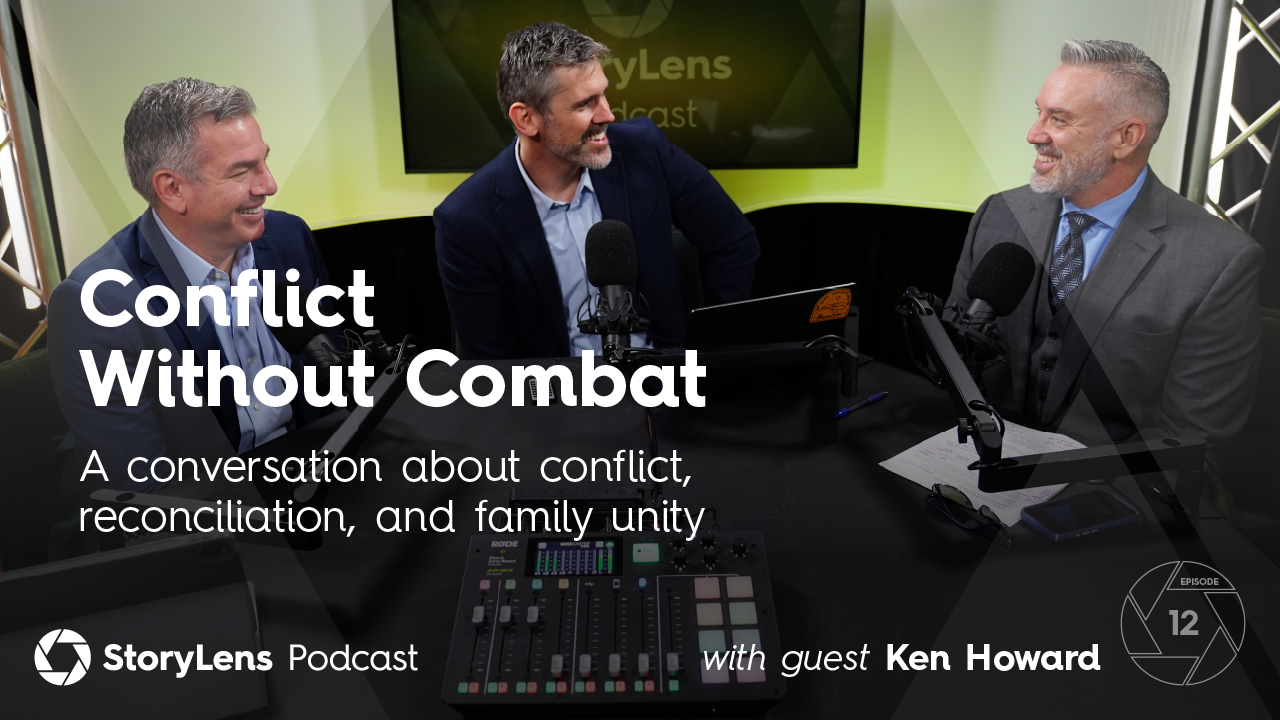
19 Mar Conflict Without Combat: A Conversation with Ken Howard, Marriage and Family Therapist
Families connected by shared enterprises, inherited assets, or a well-known name within a community rarely have the option of clean separation when relationships fracture. They stay bound by what they or previous generations built together, and without the skills and tools to navigate disagreements, those connections can become liabilities rather than assets.
In this episode of the StoryLens Podcast, John Christensen and Cameron Bond sat down with marriage and family therapist Ken Howard to examine the difference between conflict and combat, why reconciliation is a learned skill, and how families can begin repairing what has broken.
Why does relational health have a deeper impact for families with significant wealth?
Because they cannot simply walk away.
Families with multigenerational wealth are often connected as beneficiaries of the same trusts, board members or employees of a family business, co-owners of shared real estate, or as members of a well-known family within a given community. The connections within these families are deeper and more numerous than in most.
In families without that kind of shared wealth, relational fracture eventually produces distance. The younger generation disengages, disperses, and rebuilds separately. That natural off-ramp often does not exist when families share business partnerships, trusts, family limited partnerships, co-owned real estate, or shared governance structures. Those structures keep fractured families in operational proximity long after the relationships have broken down. The dysfunction does not stay personal; it enters the boardroom, the investment committee, the estate plan.
There is a path back and proactive steps that can be taken. Families that invest in relational skills alongside their financial infrastructure can build something that enhances the wealth itself: a culture of healthy conflict and genuine reconciliation that carries across generations. That takes intentionality. Ken Howard’s framework is not family therapy dressed up for a podcast. It is a practical clinical framework for families navigating the intersection of wealth, governance, and relationships. The cost of ignoring it shows up in legal fees, failed transitions, and estates that were once structurally sound but fracture under relational insolvency.
What is the difference between conflict and combat?
Combat seeks victory. Conflict seeks connection.
When an interaction becomes combative, the goal shifts: someone must lose for someone else to win. That dynamic erodes trust at a structural level. It does not matter how the surface conversation resolves; the underlying framework is adversarial, and relationships absorb that cost.
Healthy conflict has a different objective. The goal is not to defeat the other person but to understand them, be understood in return, and strengthen the relationship through the process. When conflict is handled well, it functions as a trust-building mechanism, not a threat.
Why do so many families struggle with conflict?
Most people never learn healthy relational skills. They inherit the ones they watch being used by their parents, grandparents, or others.
Therapists call this latent learning: the patterns absorbed through observation rather than instruction. Children are not taught how conflict functions in their family; they watch it. They internalize what gets suppressed, what escalates, what gets weaponized. By the time those patterns are visible, they are already structural.
Families that avoided conflict in previous generations tend to produce the next generation that either avoids it the same way or overcorrects into combat. Neither is functional. Neither was chosen.
How do unresolved relational wounds affect family systems?
They accumulate, and the family system eventually cannot absorb or process them.
Unaddressed emotional pain does not disappear. It builds beneath the surface until the system cannot contain it. Sometimes this is a single unresolved incident; sometimes it is a repeated pattern. Either can become a fracture. Families that lack the skills to address wounds early enough will eventually experience either escalating conflict or a slow drift into disconnection.
In families with shared enterprises or inherited assets, those fractures carry financial consequences. A family council that becomes a proxy battlefield, an estate plan that collapses under beneficiary or trustee disputes, a succession plan for a business that fails not because of tax structure but because the relationships couldn’t hold it. These are operational failures with relational origins.
What is the difference between forgiveness and reconciliation?
Forgiveness cancels the debt. Reconciliation rebuilds the trust.
Forgiveness is a decision: the acknowledgment of harm and the release of the claim against the person who caused it. It is unilateral and does not require any change in the other party.
Reconciliation is a process. It unfolds over time through demonstrated behavioral change: not promises, not apologies, but consistent evidence that something has changed. Trust is rebuilt by repetition. There are no shortcuts.
Families that conflate the two often forgive repeatedly without rebuilding anything. They release the debt but never address the underlying pattern, and the cycle repeats.
How should families involve the next generation in giving?
Intentionally and early.
Assuming the next generation will “figure it out” often leads to confusion or disengagement. Just like business succession, charitable succession requires communication, shared values and clear vision.
When families invite children and grandchildren into the giving conversation, generosity becomes a unifying force rather than a burden.
Why is humility so important for relational change?
Because high performers are accustomed to solving problems with the skills and tools that made them successful. Relational problems may not respond to those same skills or tools.
The competencies that produce professional success (decisiveness, high standards, competitive intensity, efficiency under pressure, a high drive) are frequently the exact behaviors that damage close relationships. Recognizing this mismatch requires the willingness to be a beginner in a domain where you are not an expert.
That recognition is the threshold. On one side of it, the pattern continues. On the other, learning becomes possible.
How can families begin developing healthier ways to navigate conflict?
By deciding that the current pattern is a choice, not a fixed condition.
Even deeply entrenched relational patterns are the product of learned behavior, which means they can be replaced by different learned behavior. The process is not quick, and it is often not comfortable. But it is accessible. Families that have spent decades in dysfunctional relational patterns have restructured them. The precondition is the willingness to try something new and to practice it long enough for it to take hold.
The goal is not a family that never has conflict. The goal is a family that knows how to have conflict without destroying what matters.
Stay Connected
Stay connected with the StoryLens Podcast for future conversations. Your story is anything but ordinary—and that’s exactly where we begin.